
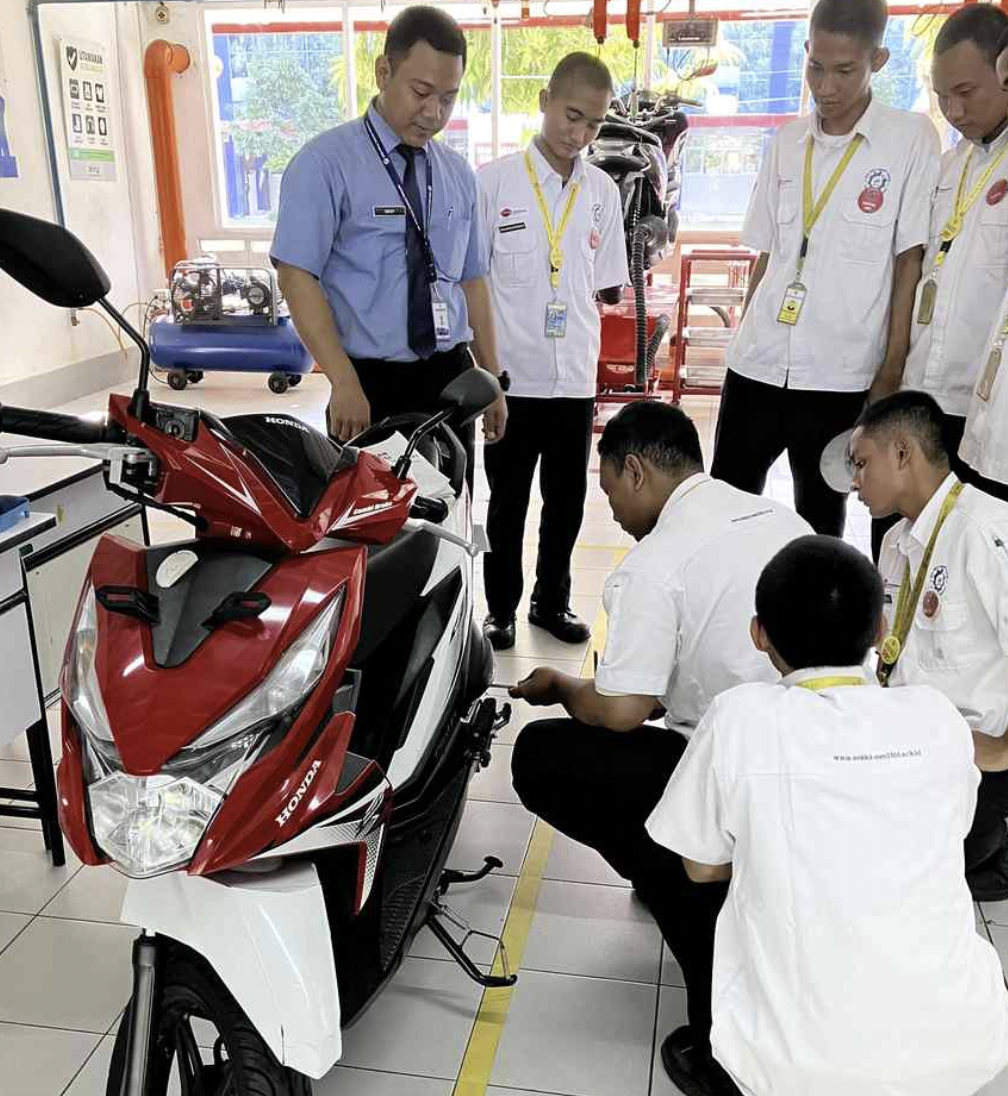

Japanese companies are increasingly investing in an unusual but well-planned tool in the Southeast Asian region: education. By setting up vocational schools based on the training system used in Japan, the companies plan to not only have a steady supply of skilled employees at their disposal but also be in a better position to face the rapidly rising Chinese and South Korean competitors.
In the industrial suburbs of Jakarta, 16-year-old Rizky aspires to be a worker at a Japanese car company someday. “I really love the sound of Japanese car engines,” he says while studying car maintenance at Politeknik Mitra Industri, a vocational school formed in 2012 inside an industrial park that is the joint venture of Marubeni Corp. and other companies.
The park is the home of 385 companies, among which are Honda Motor and Denso. Eight specialized programs, ranging from machinery to electronics and accounting, had approximately 3,400 students enrolled. More than 70% of students from 2015-2024 have found employment in Japanese companies after graduating, which is an indication of the school’s role as a recruitment hub.
Skills, however, are not the only thing that companies gain. In developing countries, businesses are often burdened with the high cost of having to train recruits even in the most basic workplace habits. Graduates from these programs become not only technically equipped but also they are already trained in the discipline aspect of Japanese corporate culture.
“We intend to develop a setting whereby students acquire cutting-edge knowledge and mature into future leaders for the manufacturing sector,” said Yoshihiro Kobi, a former Marubeni executive who is currently the school supervisor. A technical university is being planned to open this September, extending the chance of studying to working adults.
Soon, other Japanese companies would also take similar actions. In 2018, Toyota Tsusho Corp. inaugurated a technical institution in Gujarat, India, which offered training and manufacturing skills for three years. Among 61 graduates, 72% found employment in Japanese companies. The same was the case in Thailand, where a technical college established in 2019 with the support of the Japanese government has become a source of trained employees for Japanese manufacturers operating there.
Nonetheless, talent competition is also a reflection of the intensification of rivalry. Instead of merely establishing themselves alone, Chinese and South Korean firms are also aggressively putting up their plants in Southeast Asia. Consequently, they are enticing workers with higher salaries, thus seducing them away from Japanese employers. The surveys show that compared to just a few years ago, less of young Southeast Asians now harbor the ambition of working for Japanese companies, implying Tokyo’s corporate giants are confronted with a threat.

