
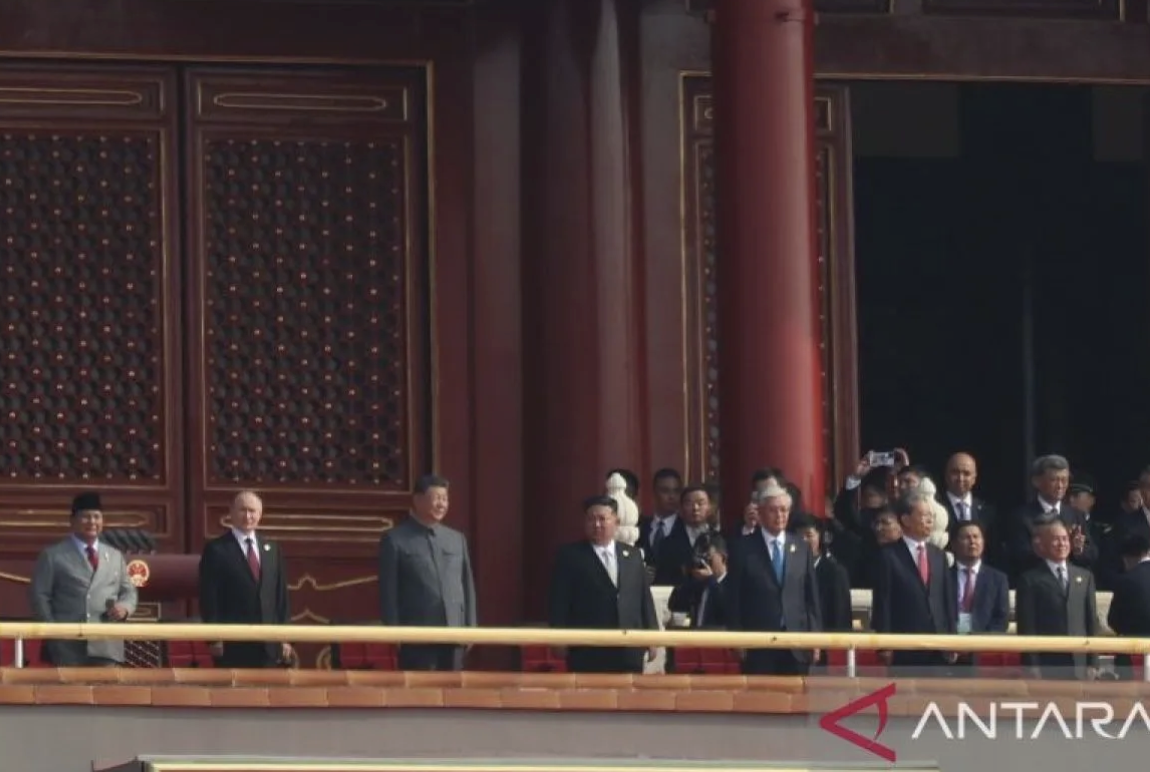

The Victory Day military parade held in Beijing, China, saw a premier appearance by the Indonesian President Prabowo Subianto. On the honorary platform at the event, along with the Chinese leader Xi Jinping, Russian President Vladimir Putin, and North Korea’s Kim Jong Un, he shared the stage. The Tiananmen Square event to commemorate the 80th anniversary of Japan’s World War II defeat, which included the display of advanced Chinese military capabilities, was attended by 26 nations, signaling Beijing’s ambition to extend its geopolitical influence.
Prabowo disregarded the unrest arising in his country and flew off to Beijing, a situation where the anti-government protests had escalated to fatalities. The signal he sent was loud and clear: despite the chaos at home, he is committed to close ties with China and assures Indonesia’s strategic partnership. Xi went on to support Prabowo and leadership stability in Indonesia through remarks after the latter’s participation, which is an additional move of China embedding itself in regional geopolitics through diplomatic gestures of solidarity.
The event allowed the Chinese to display an extensive range of their military technology, from hypersonic missiles to drones, cutting-edge air defense systems, and versatile aerial platforms, thus giving an insightful representation of the military’s capabilities and technological practice. Prabow,o being among such as Putin’s and Kim’s like-minded leaders, showcased China’s widening cosmopolitan sphere of influence and the moves by China to deepen ties with non-Western and authoritarian regimes.
Considering the domestic unrest, critics can possibly see Prabowo’s attendance as a somewhat disrespectful act, manifesting political resistance by using international diplomacy as a way of balancing domestic weakness. By being in the lineup with such as Putin, Xi, and Kim, who are often at variance with the West, Prabowo took the place of Indonesia amid the intricate diplomatic balancing act that leans towards economic and strategic partnership with China on one hand, and while raising suspicion from democratic allies on the other hand, nd who are concerned about autocratic entanglements.
Prabowo’s presence at the event is, in essence, an indication of Southeast Asia’s changing diplomacy, where leaders may choose Beijing as their partner for security and economic development amid global polarization. While facing protests and political volatility at home, Prabowo’s trip is, therefore, a reminder that regional alliances are not only influenced by the external powers’ interests but also by the leaders’ internal judgment of legitimacy, stability, and influence.

