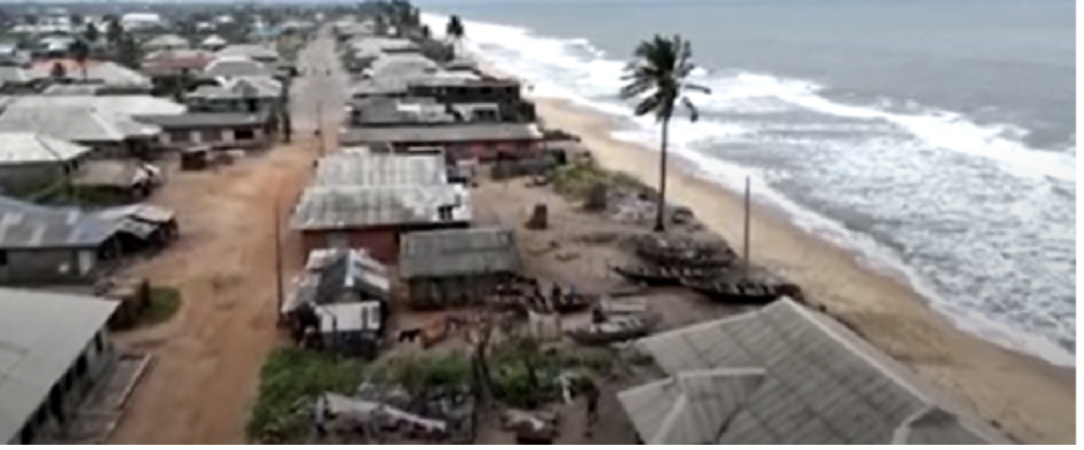
In June, an ocean surge went through the village of Apakin and this has led to the loss of fishing boats, nets, and the graves of one of the last indigenous Lagos coastal communities.
With about 3,000 people, this settlement is now the next victim to the rising water that are affecting the coastline of Nigeria.
Local chief Abimbola Iyowun told about the ongoing devastation to his ancestral home and noted that from the graves of his father’s lineage only two of them remain.
Iyowun remarked that the houses of him and his father are underwater and people are having a hard time finding new places for the graves they can relocate to.
As per a 2022 report in the Journal of African Earth Sciences, almost the entire (80%) of the Lagos shoreline has been lost during the last 50 years.
The research points out the building of deepwater ports along the Bight of Benin as the major cause of the coasts that furthers the erosion of the affected local communities.
The residents of Apakin say they are among those who have suffered a great deal from twelve coastal communities in Lagos that have been battling ocean surges.
The last 50-meter stretch of coconut trees was lost to the village four years ago, while the palace of Iyowun went under three years after his installation as village head.
Lagos State sees the rising sea as the most significant long-term climate threat, but environmentalist Philip Jakpor believes that the projects supported by the government lead to the destruction of the coast.
Jakpor said that the dredging activity forces water to flow to the communities, thereby making their destruction faster.
Nigerian activist Akinbode Oluwafemi lambasted the 2022 Commonwealth Living Lands Charter adopted in Kigali, Rwanda, describing it as non-binding and ineffective.
Oluwafemi remarked that although the declaration recognizes human activities as the main cause of climate change, it still lacks real accountability measures for corporations that contribute to the crisis.