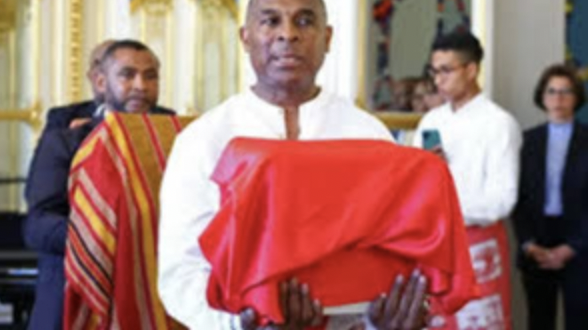
France has officially handed over the skull of King Toera as well as that of two other members of the court of Madagascar during a ritual at the Culture Ministry in Paris.
The Museum of Natural History in Paris, where the remains had been kept for over a century, had received the bones at the end of the 19th century after they were taken from Madagascar.
The king was killed by French troops who then decapitated him as part of a colonial campaign to dominate the Menabé kingdom of the Sakalava people in the west of Madagascar in August 1897.
The French unit slaughtered the local army and thus sent the king’s head to the museum’s archives in Paris.
At the event, French Culture Minister Rachida Dati pointed out that the skulls “were part of the national collections acquired under circumstances that most probably violated human dignity and in a context of colonial violence”, as reported by AFP.
The return of the handover is the first occasion of implementing a new French legislation which is made to streamline the transfers of human remains from collections.
Museum of Natural History in France retrieved the skulls more than a hundred years ago, and they have been the visible sign of a “deep, open wound in Madagascar’s heart, the island that we are,” Culture Minister Volamiranty Donna Mara told AFP, adding that “their absence had been, for more than a century, an open wound in the heart of our island”.
Affected by the power of the king and the government of Madagascar, the royal family made it easier for the family to be returned.
Before that, the French government had already repatriated the remains of colonial times, including those of a South African woman called the “Hottentot Venus” in 2012.
The Museum of Natural History alone houses over 20,000 human biological specimens that have been collected globally for scientific research.